
Most service businesses hit a wall around 10 employees. Not a revenue wall — an ops wall. You hired a coordinator to handle intake. Then a second one because the first couldn’t keep up. Then someone to do follow-up because both were drowning in scheduling. What you’re actually buying isn’t talent. It’s operational capacity. And there’s a cheaper, more scalable way to replace your operations team than payroll.
The Ops Hiring Trap
Here’s the pattern in almost every new engagement:
- A founder hires an ops coordinator at $50K–$65K base ($75K–$85K fully loaded).
- Six months later, the coordinator is at capacity.
- The founder hires another one.
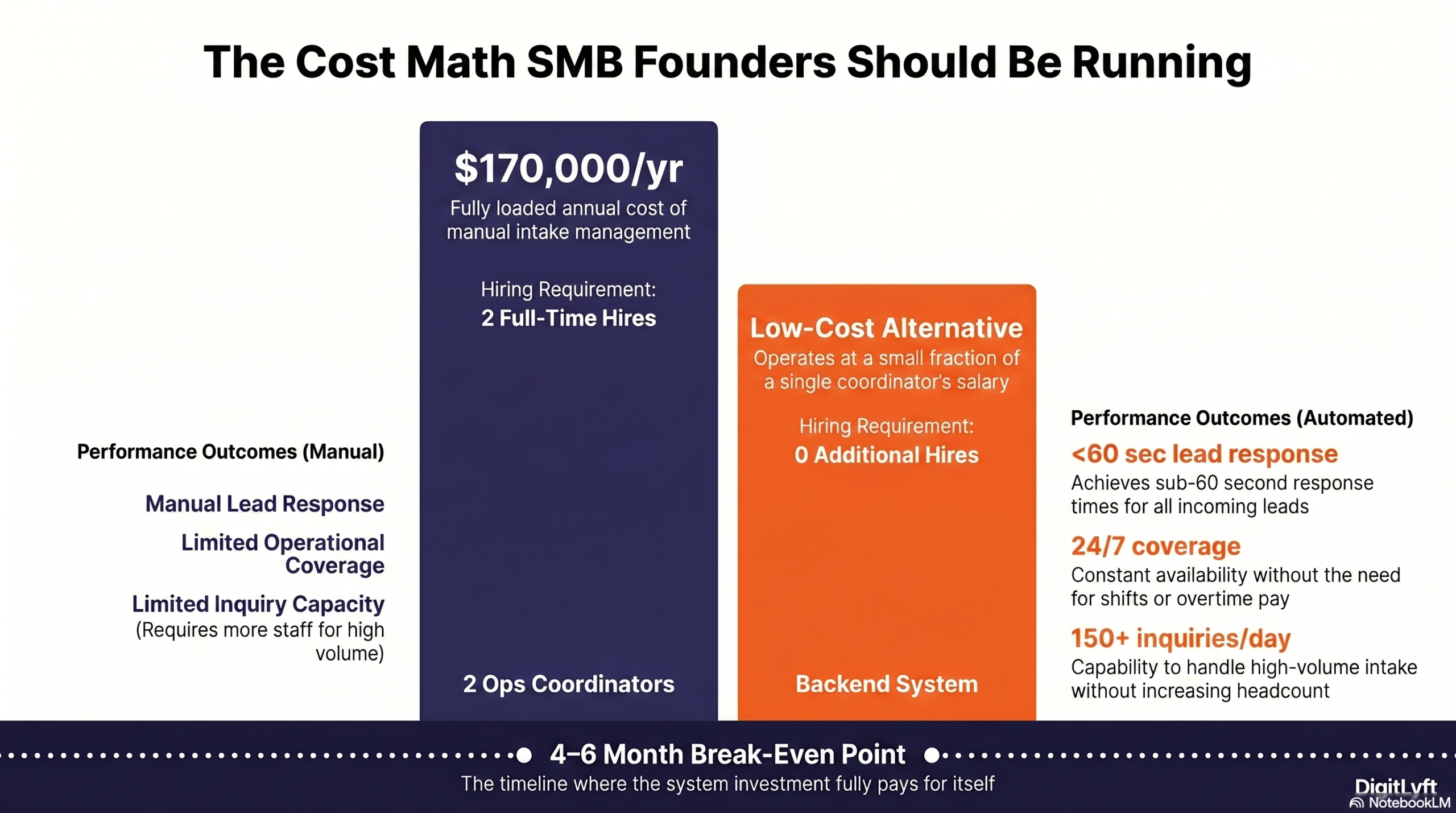
- Now they have two coordinators, a management layer, and roughly $170K/yr in ops labor — doing work that should take 20 hours a week.
The problem isn’t the people. The problem is that manual ops tasks — intake, follow-up, scheduling, reminders, reporting — don’t require judgment most of the time. They require consistency and speed. That’s not a human advantage. That’s a systems advantage.
We’ve seen this break badly at dental practices that hired a third front-desk person to handle recall campaigns — and still had patients slipping through. At law firms that hired an intake paralegal who quit after eight months because the work was too repetitive. At real estate teams paying an ISA $60K/yr to respond to Zillow leads — while leads sat cold for 4–6 hours because the ISA was at lunch.
What a Backend System Actually Replaces
A backend system isn’t a chatbot on your website. It isn’t a Zapier workflow that breaks when an API changes. It’s a custom-built operations layer — software, AI agents, and data pipelines — that runs inside your business and does the work a coordinator would do.
In our builds, a Tier 1 ops replacement system handles:
- Intake and triage: Every inbound inquiry — phone, web form, email, referral — processed, qualified, and routed without a human reading it first.
- Follow-up: Leads that don’t book immediately get contacted at 7, 14, and 30 days with context-aware messages — not generic drip emails.
- Scheduling: Meetings booked directly to your calendar. Rescheduling and cancellations handled the same way.
- Reporting: A dashboard showing what the system handled, what it escalated, and why — without building a spreadsheet on Fridays.
The system touches multiple tools your business already uses — your CRM, your phone system, your calendar — and runs without anyone pressing a button. It escalates the 5–10% of cases that need a human. The rest it handles entirely.
Which Ops Roles Get Replaced First
Not every ops role is equally replaceable on day one. Based on what we’ve built across dozens of SMB deployments, here’s the priority order:
1. Inbound lead coordinator / ISA
This is the easiest replacement. The work is almost entirely rule-based: respond to inbound, qualify against criteria, book the meeting, log to CRM. A backend system does all of it in under 60 seconds, 24/7. Real estate teams running this system have recovered $10M+ in deals that previously went cold because no one responded fast enough.
2. Front-desk / intake staff
Dental practices, law firms, and medical offices run on intake volume. A backend system handles 150+ inquiries per day — scheduling, rescheduling, recalls, reminders — without a human on the phones. At dental deployments, we consistently see 30%+ lower scheduling costs from eliminating the labor and error rate of manual scheduling.
3. Follow-up coordinator
The job is pure execution: send email at X days, call at Y days, log result, repeat. No judgment required. A system does it faster, with better logging, and at zero incremental cost per contact.
4. Ops analyst / RevOps coordinator
CRM hygiene, pipeline reporting, deal-stage updates — this role exists because sales reps don’t update CRMs reliably. A backend system reads real activity (emails, calls, calendar events) and updates fields automatically. Your pipeline report reflects reality instead of hope.
What we don’t replace immediately: high-judgment roles like account management, strategic ops decisions, or anything requiring relationship context. A backend system handles the 80% that’s execution. Your team keeps the 20% that needs a human.
The Cost Math You Should Be Running
Before scoping any build, we run this with every client:
- One ops coordinator: $50K–$65K salary + benefits + taxes + management overhead = $75K–$90K/yr fully loaded.
- Two coordinators: $150K–$180K/yr — running 9-to-5, five days a week.
- A backend system replacing those two roles: one-time build fee + monthly run cost that’s a fraction of one salary. Operational 24/7.
Most clients break even on build cost within 4–6 months. After that, every month the system runs is $6K–$15K in labor they’re not spending.
We’ve seen this math work for a 12-person law firm, a 20-person real estate team, a 3-location dental practice. The variables change. The outcome doesn’t: you stop hiring for the role, and the work keeps getting done.
The Failure Modes of Doing This Wrong
Three common ways businesses get this wrong — usually because they bought a tool instead of a system.
The Zapier trap: You connect five tools with a workflow. Works for the first 200 records. Then an API changes, a field gets renamed, a contact arrives with an edge-case format — and the workflow silently fails. No one notices until leads have gone cold for a week. A backend system has error handling, alerting, and fallback paths. A workflow tool doesn’t.
The tool-plus-headcount trap: You buy a CRM and hire someone to run it. Now you have the tool cost and the headcount cost. The tool didn’t replace the person — it gave the person more to manage. This is how SMBs end up with six SaaS subscriptions and the same number of ops hires they had two years ago.
The widget trap: You put a chat widget on your website and call it your intake system. It handles 15% of inquiries — the simple ones. The other 85% still go to your coordinator. Nothing got replaced. You added a layer.
In our builds, we start every engagement by mapping what actually needs to happen — every step, every edge case, every handoff — before writing a line of code. That mapping is what separates a system that replaces a role from a tool that adds to one.
Signs You’re Ready for an Ops Replacement System
You’re a fit if:
- You’ve hired the same ops role more than once in the last two years.
- You have a repeatable process that runs more than 20 times per week.
- You’re losing revenue or client satisfaction because that process runs too slowly or inconsistently.
- You’re spending more than $60K/yr on the role responsible for that process.
If you check two or more of those, the math almost certainly works in favor of a build. If you’re unsure, that’s what the audit is for.
Explore our operations replacement systems to see how Tier 1 builds are scoped across sales ops, customer ops, content ops, and revenue ops.
What the Build Process Looks Like
Most Tier 1 systems — those that replace a full ops role — ship in 4–8 weeks:
- Ops audit (weeks 1–2): We map every step of the manual process, identify where it breaks, and quantify the cost. You get a build scope with a specific outcome attached.
- System design (weeks 2–3): We spec the integrations, decision logic, escalation paths, and reporting layer. You approve before we build.
- Build and test (weeks 3–6): Built and tested against real cases from your business — not just clean ones. Edge cases handled before go-live.
- Deployment and handoff (weeks 6–8): System goes live, your team gets a runbook, and we monitor the first 30 days. You get a dashboard showing what it’s handling daily.
After deployment, your ops coordinator either moves to higher-judgment work or is the last hire in that role. Either outcome is fine. Our job is to stop the compounding headcount, not displace people doing work that actually needs them.
Book a 30-minute ops replacement audit — We’ll map what your team is doing manually, quantify it, and show you what a backend system replaces. Free, no pitch if it’s not a fit.